
Best Types of Puzzle Toys for Beagles: A Practical Buying Guide
Snuffle mats, treat balls and sliding puzzles compared — how to pick the right difficulty, size and material for a scent-driven Beagle, and how to keep toys safe and clean.
5 min read
Why scent-driven enrichment matters
Beagles were bred to search for scent, often for hours. Modern pet Beagles keep that drive, but everyday life rarely gives it an outlet. Puzzle toys turn part of mealtime into a short search-and-solve task, which many owners find helps a busy Beagle settle.
Puzzle toys are not a replacement for walks, company or training, but they are a simple way to add mental work to a day — particularly on rainy days or when exercise must be limited on your vet's advice.
Types of puzzle toys
Most puzzle toys fall into a few broad groups. Each works a slightly different skill.
Snuffle mats
Fabric strips sewn onto a base hide kibble or small treats. Your Beagle uses its nose to search. They are usually a gentle starting point and use the breed's strongest skill. Supervise use: some dogs chew the fabric.
Treat-dispensing balls and wobblers
Food drops out as the toy rolls or tips. These encourage movement as well as problem solving and can slow down fast eaters. They can be noisy on hard floors.
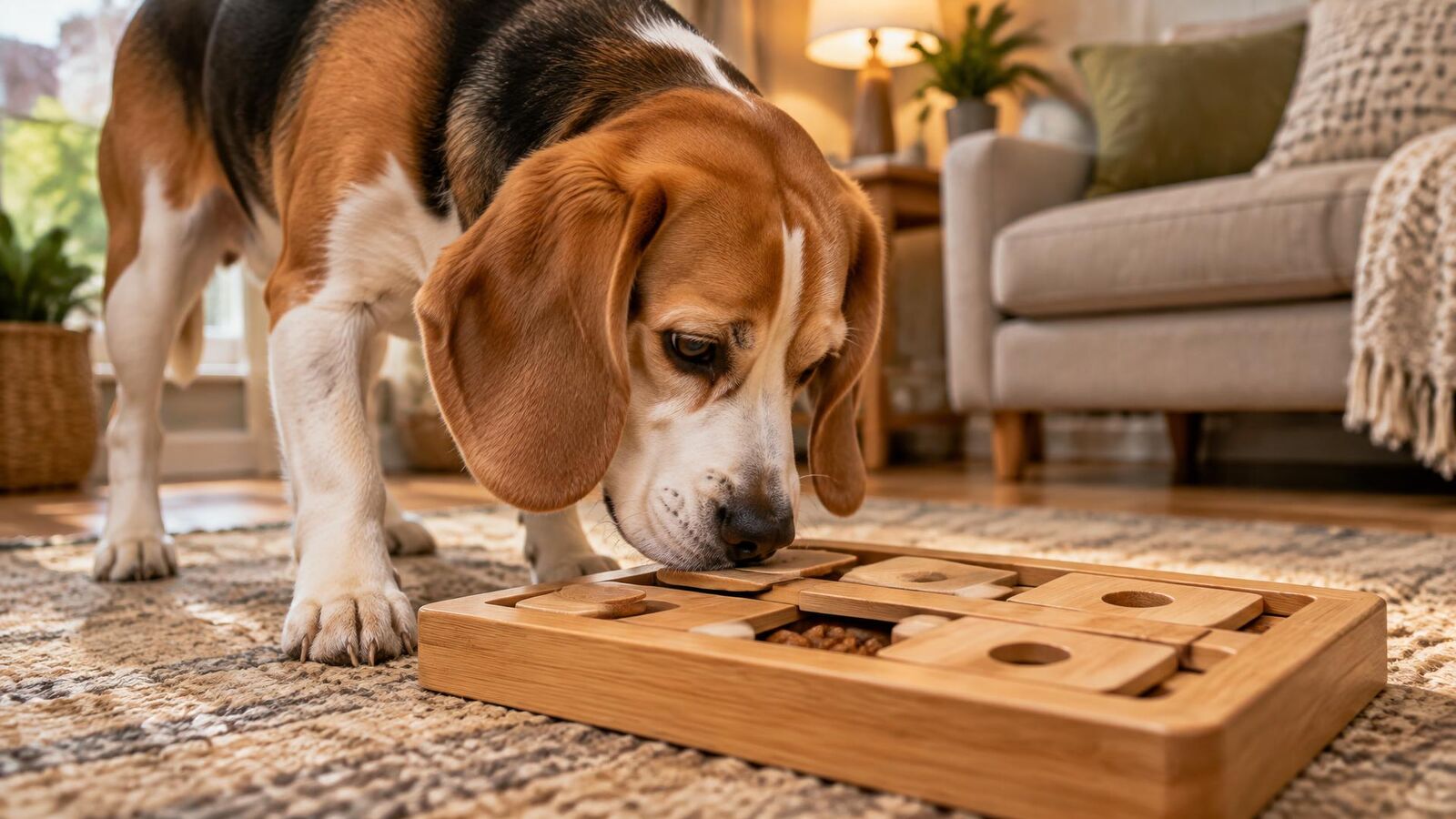
Sliding and flip puzzles
Boards with lids, sliders or flaps that hide food in compartments. They range from very simple to multi-step. Small loose parts can be a chewing hazard, so choose designs where pieces are fixed or too large to swallow, and always supervise.
Stuffable rubber toys
Hollow, durable rubber toys can be filled with part of a meal. Licking and working food out can be calming. Freezing the filling makes the task last longer.
Food puzzles versus scent games
Food puzzles ask your dog to manipulate an object — push, roll or lift — to reach food. Scent games ask your dog to find hidden food or a scented item using its nose alone, with no toy required.
Both are valuable. For many Beagles, scent games are the more natural activity and cost nothing: hide a few treats around a room, say "find it" and let your dog search. Puzzle toys add variety and are easy to use when you are busy. Our guide to keeping your Beagle mentally stimulated has more scent game ideas.
Comparison of common puzzle toy types
Use this table as a general guide; individual designs vary, so always follow the manufacturer's instructions.
| Toy type | Typical difficulty | Main skill | Supervision | Cleaning |
|---|---|---|---|---|
| Snuffle mat | Easy | Sniffing | Yes, especially if your dog chews fabric | Usually washable; check the label |
| Treat ball or wobbler | Easy to moderate | Pushing and rolling | Recommended at first | Usually simple; check whether it comes apart |
| Sliding or flip board | Easy to advanced | Problem solving | Always | Wipe clean; avoid soaking wood |
| Stuffable rubber toy | Easy to moderate | Licking and chewing | Recommended | Often dishwasher-safe; check instructions |
How to choose the right difficulty
Start with a puzzle your Beagle can solve within a minute or two. Early success keeps them interested; frustration often leads to chewing or abandoning the toy.
Increase difficulty in small steps: use fewer or smaller openings, hide food deeper in a snuffle mat, or move to a board with two-step compartments. If your dog starts pawing roughly, barking at the toy or giving up, go back a level.
- Beginner: snuffle mat with food scattered on top, treat ball with large openings, sliding board with lids already half open
- Intermediate: snuffle mat with food buried deeper, wobbler toys, boards with simple lift-and-slide compartments
- Advanced: multi-step boards that need several actions in sequence, frozen stuffable toys
Sizing and safety
Choose toys that are too large to be swallowed and robust enough for your dog's chewing style. Check toys before each use and remove anything cracked, torn or missing parts.
Supervise your Beagle with any new toy until you know how they use it. Puzzle toys are generally meant for supervised play rather than to be left with a dog alone. If your dog has a medical condition, a special diet, or is overweight, talk to your vet about how to include puzzle feeding in their daily food allowance.
- Avoid small removable pegs or pieces on boards for chewers
- Choose non-toxic materials and follow the manufacturer's age and size guidance
- Use part of the daily food ration rather than adding extra treats
Cleaning and durability
Food residue builds up quickly. Wash puzzle toys regularly according to the manufacturer's instructions, and dry wooden or fabric toys fully before the next use.
Durability depends on materials and your dog's habits. Fabric mats suit gentle sniffers; rigid plastic or rubber is often better for enthusiastic dogs. Replace toys once they show damage.
Practical buying criteria
Before buying, ask:
- Is it the right size for an adult Beagle (or a puppy, if relevant)?
- Can my dog swallow or chew off any part?
- Is the difficulty adjustable as my dog improves?
- How is it cleaned, and are the instructions clear?
- Does it hold enough food for part of a meal?
- Is the manufacturer clearly identified, with safety and material information?
About product recommendations
Beagle Nest has not tested specific puzzle toy brands, so this guide does not name or rank products. We will only add named recommendations when product details have been verified, and any affiliate links will be clearly disclosed. For durable chewing options, see our guide to the best toys for Beagles that love to chew.
Frequently Asked Questions
How often should my Beagle use a puzzle toy?
Many owners use one for part of a meal once or twice a day. Rotate a few types so the challenge stays interesting.
Can a puppy use puzzle toys?
Yes, with easy, puppy-appropriate toys and close supervision. Start with snuffle mats or simple treat balls.
Related Articles
Best Types of Chew Toys for Beagles: A Safety-First Guide
Compare chew toy types by fit, flexibility and cleaning—not promises of indestructibility—and learn when to remove a damaged toy.
How to Keep Your Beagle Mentally Stimulated
Simple scent games, achievable food puzzles and short training sessions for a curious Beagle—with time to relax between activities.